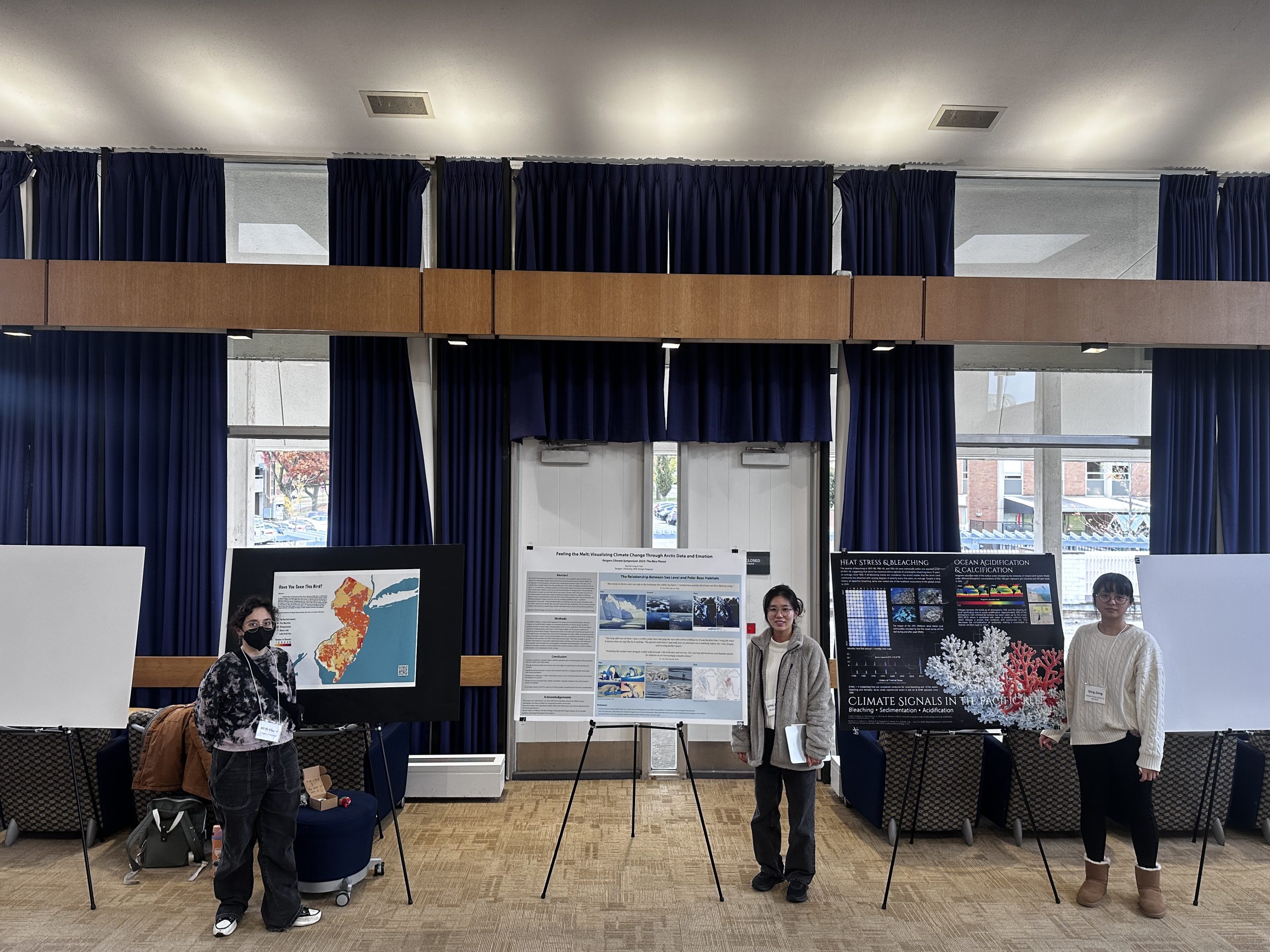
As part of the interactive poster sessions, three MFA students in Design—Ali El-Chaer, Rachel Jung A. Huh, and Iris Qing Zeng—presented research-driven projects developed in their Research Methods course, which emphasizes the integration of quantitative data and qualitative narratives as a framework for climate communication.
Ali El-Chaer’s project explored the disappearance of bird species in New Jersey, combining ecological datasets with regional folk tales to situate biodiversity loss within lived cultural memory. Rachel Jung A. Huh’s work traced her father’s journey to the Arctic, bringing together family photographs and scientific measurement imagery to connect personal experience with large-scale climate observation and data collection. Iris Qing Zeng focused on color bleaching as a visual and material signal of environmental stress, translating scientific phenomena into perceptible visual language.
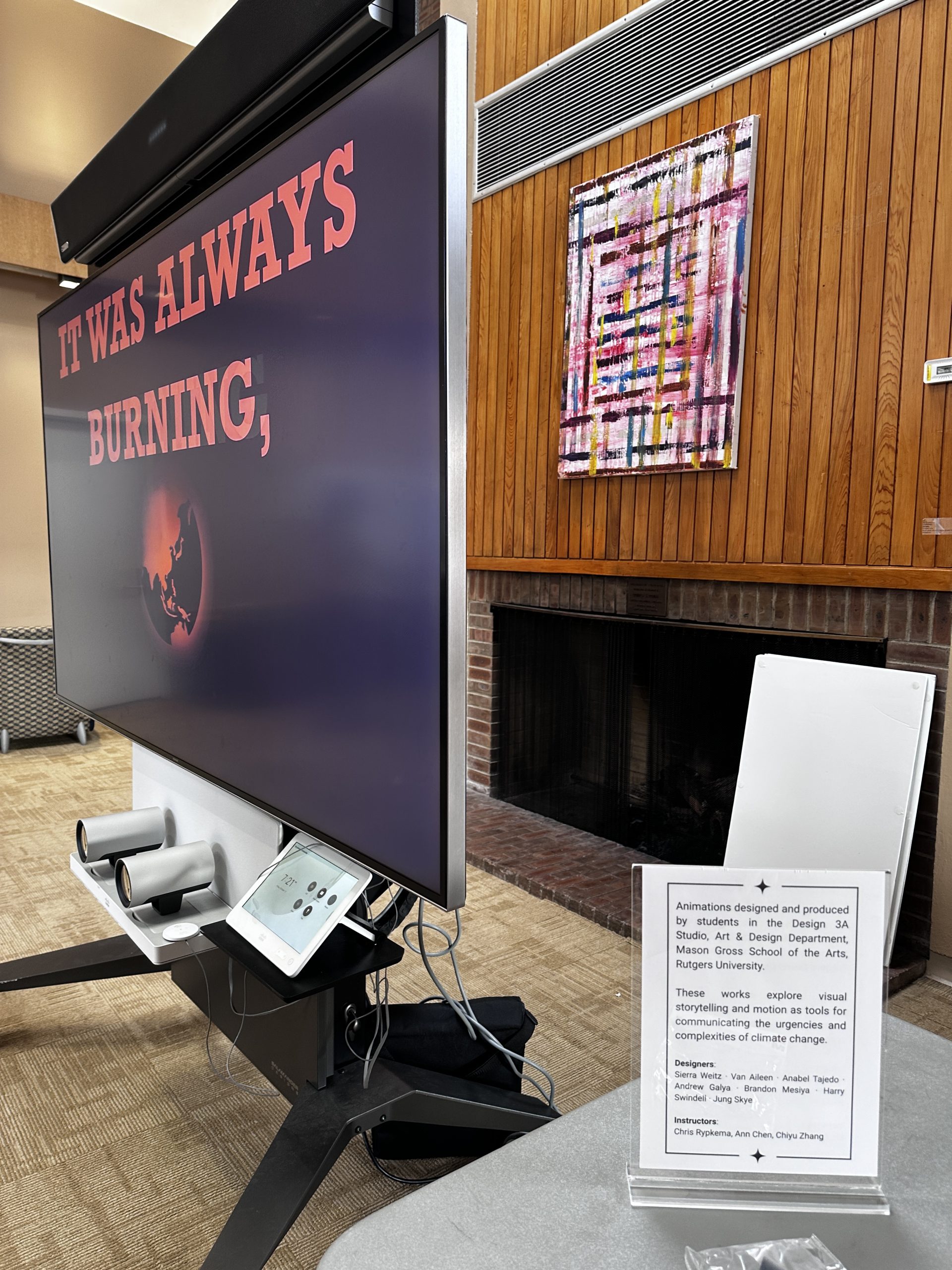
Together, these projects demonstrated how design-led approaches to data visualization and storytelling can make climate science legible, affective, and socially grounded, aligning with RCEI’s emphasis on the human dimensions of climate change. In parallel, animations addressing climate change created by undergraduate design students were also on display, highlighting how design education at multiple levels contributes to innovative, interdisciplinary climate communication.
Art After Manufactured Certainty : November 4, 2025
On November 4, the Mason Gross Design community hosted Burak Arikan, an artist, designer, and researcher whose work investigates how predictive systems shape culture, behavior, and power, and how art can intervene. Arikan’s practice spans network mapping, data politics, and collective intelligence, exposing the invisible economies and infrastructures that govern our digital lives. His projects have been exhibited at MoMA, the Museum of Contemporary Art Tokyo, and major biennials in Venice, Berlin, Istanbul, and São Paulo. He is also the founder of Graph Commons, a collaborative platform for mapping complex data networks.
Arikan began his talk by tracing the shift from 20th-century mass media: newspapers, television, radio, to today’s algorithmic platforms. What once appeared as an open social web has transformed into an economy of prediction, where every click, post, and search is harvested to anticipate future behavior. “Speech is still free,” he said. “The problem is that cognition is engineered.” For Arikan, this condition of manufactured certainty defines our current era: a system that turns uncertainty into confidence, not to inform us, but to control us.
Through his projects, Arikan turns these predictive systems into artistic material. In one work, he developed software to forecast his own bank transactions, stamping each receipt with the algorithm’s probability. By following its predictions, he demonstrated how predictive systems can fabricate the very futures they claim to foresee. In another project, he built a platform that allowed users to “IPO themselves,” issuing shares of their identities in a speculative social marketplace. Friendship, labor, and visibility became currency, reflecting how social media monetizes our relationships.
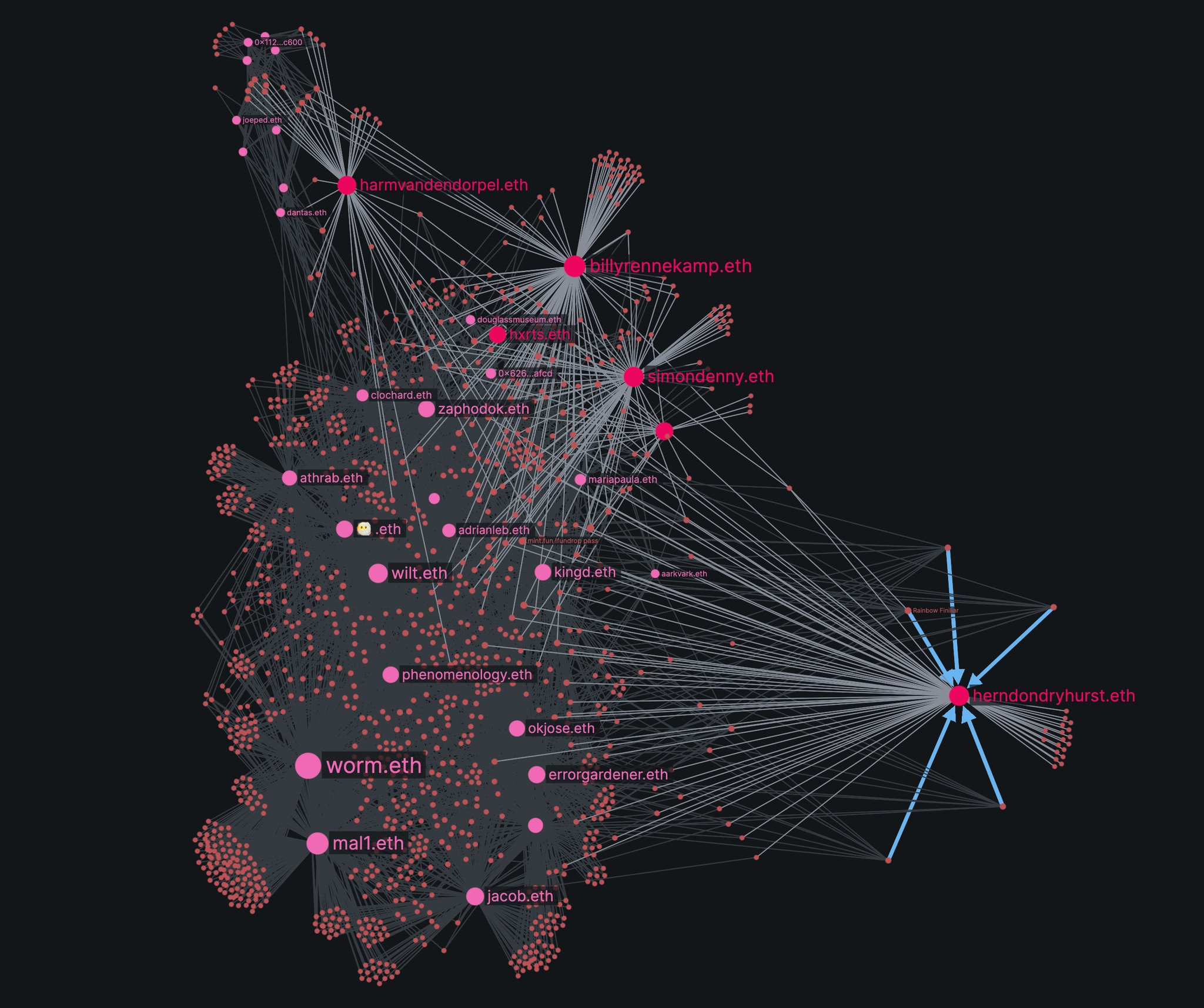
Arikan also discussed Social Contracts (2013), a project that used blockchain technology long before NFTs became mainstream. Instead of treating digital tokens as collectibles, he framed them as social sculptures, publicly visible, constantly evolving networks of ownership and connection. Each transfer of an artwork generated new relationships, mapping the circulation of power within digital culture.
Across his body of work, Arikan outlined four key principles that guide his practice: prediction, feedback, transparency, and critical friction. Together, these form what he calls Predictive Realism, an artistic approach that examines and reshapes the predictive mechanisms embedded in everyday life. His work draws from traditions of Institutional Critique, Social Sculpture, and Fluxus, expanding them for a world governed by data and algorithms.
Arikan closed with a reflection on uncertainty as a space of freedom. If our futures are being pre-written by machines, art can restore ambiguity, reintroducing the unknown as a site of imagination and agency. “Art can reveal the infrastructures that claim to predict us,” he said, “and widen the futures we are allowed to have.”