MFA Design First-Year reviews

On December 8, 2025 the MFA Design first year candidates held their semester review, focused on projects completed in Design Studio 1 taught by Sue Huang. The goal of this review was for candidates to receive feedback from design faculty on their chosen project.

Qing Zeng (she/her)

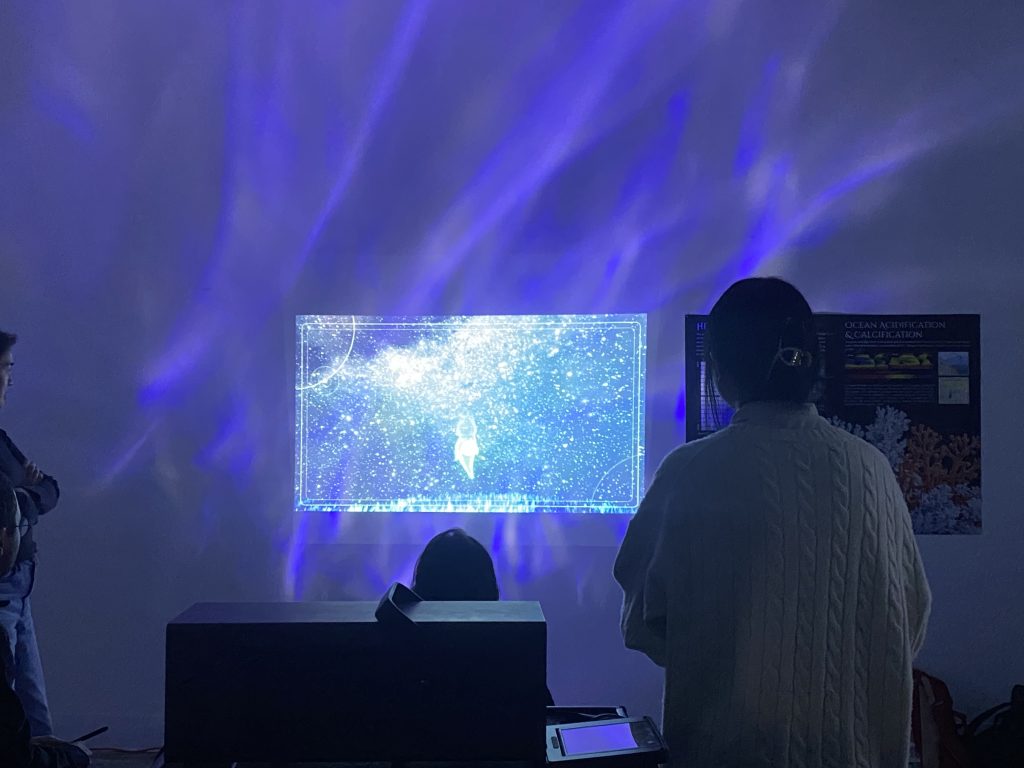
LUNE is a third person 3D narrative game that explores how individuals with social anxiety disorder (S.A.D.) can learn, practice, and internalize social coping strategies through game play, and how these learned strategies may help them regulate emotions and navigate real-world social interactions.
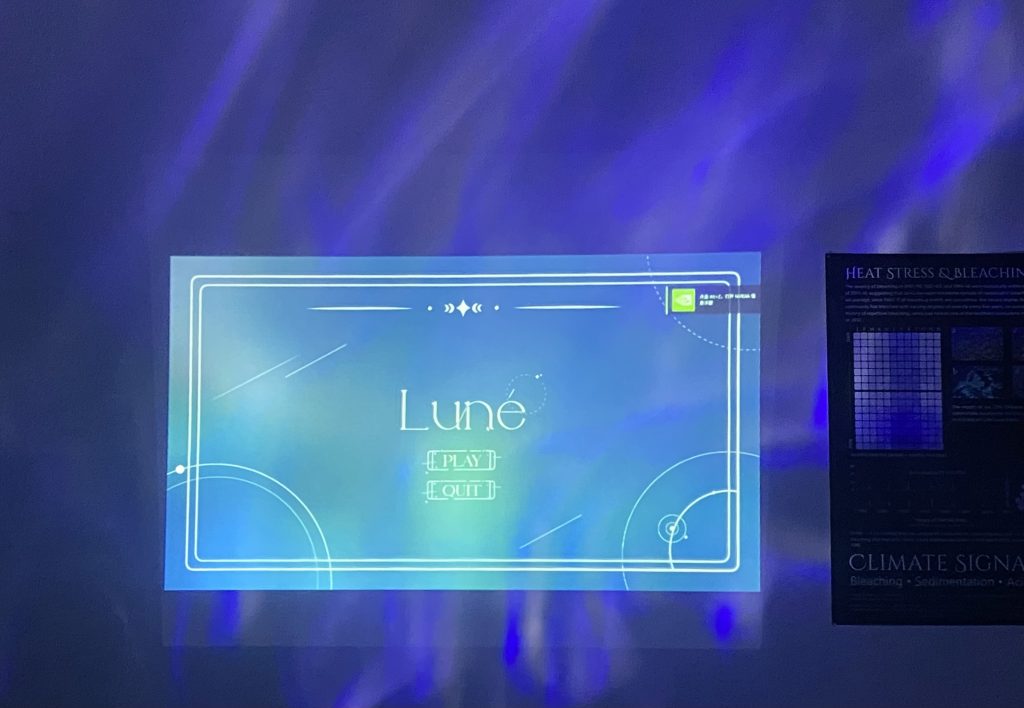
Developed in Unreal Engine 5, the game combines interactive mechanics, environmental storytelling, and character-driven encourates to simulate moments of social tension, uncertainty, and emotional overload. Players engage with others through systems such as color -based resonances, gradual trust building, and keyword collection, which was inspired by cognitive behavioral therapy (C.B.T.) and exposure based coping techniques.
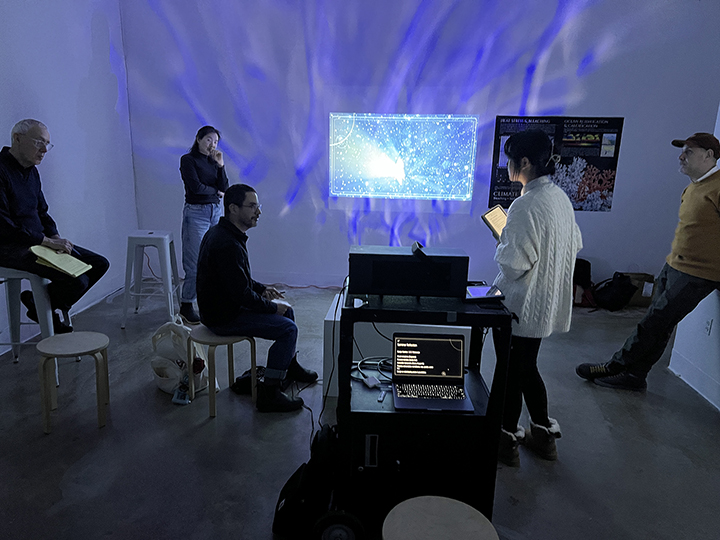
The visual assets were partially created in blender, with emphasis on symbolic character design and atmospheric environments that externalize internal emotional states. Rather than positioning S.A.D. as something to be “fixed,” LUNE frames it as as ongoing process of adaptation, learning, and self acceptance, using play as a low pressure space for emotional rehearsal and reflection.
Jung A Huh (she/her)

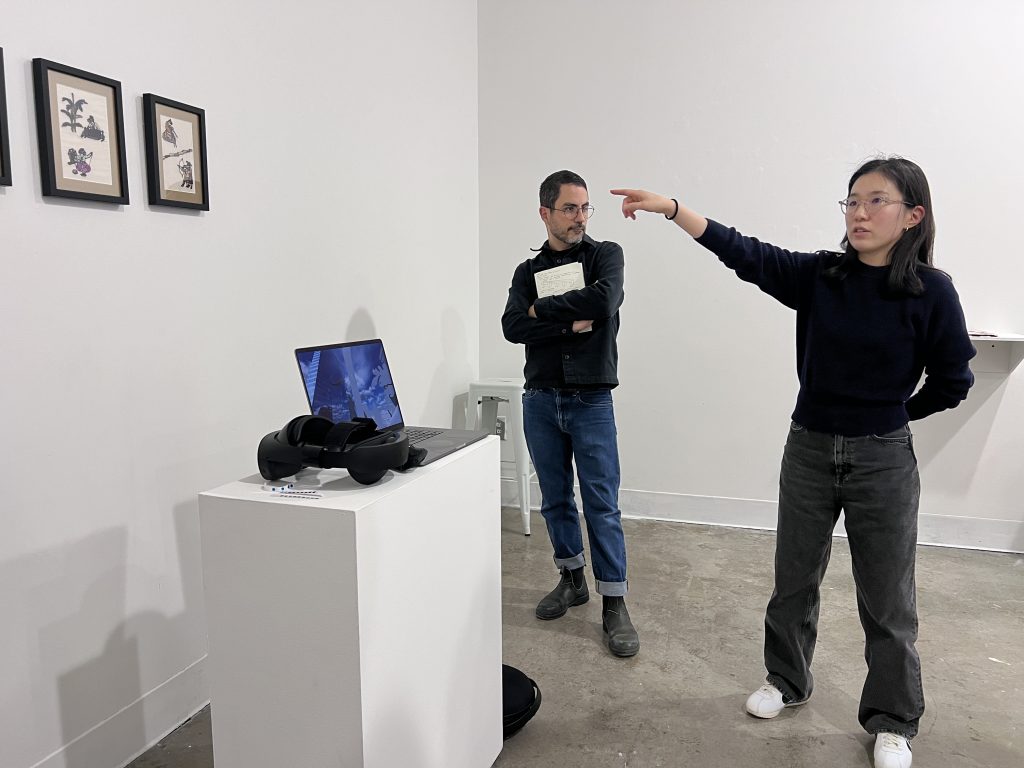
The Leisure Archive explores how notions of leisure have shifted from the Joseon Dynasty to the digital age by re-imagining historical figures through contemporary technologies. Using digital embroidery, A. I. image generation, A-Frame, and V.R., the work bridges past and future forms of leisure, questing how humans experience rest, play, and imagination across time.
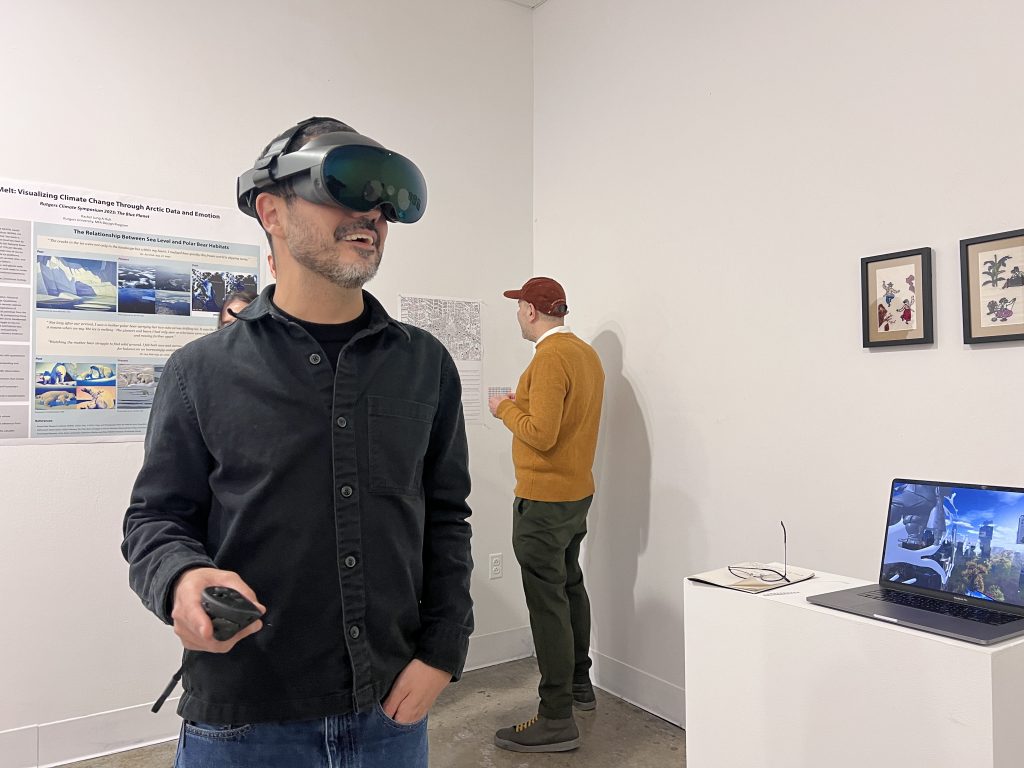
The project combines handcrafted textures with virtual environments to create a hybrid space where embroidered bodies and digital worlds coexist. Through this process it reflects on the evolving relationship between human senses, craft, and machine-mediated experiences.
Ali El-Chaer (they/he)

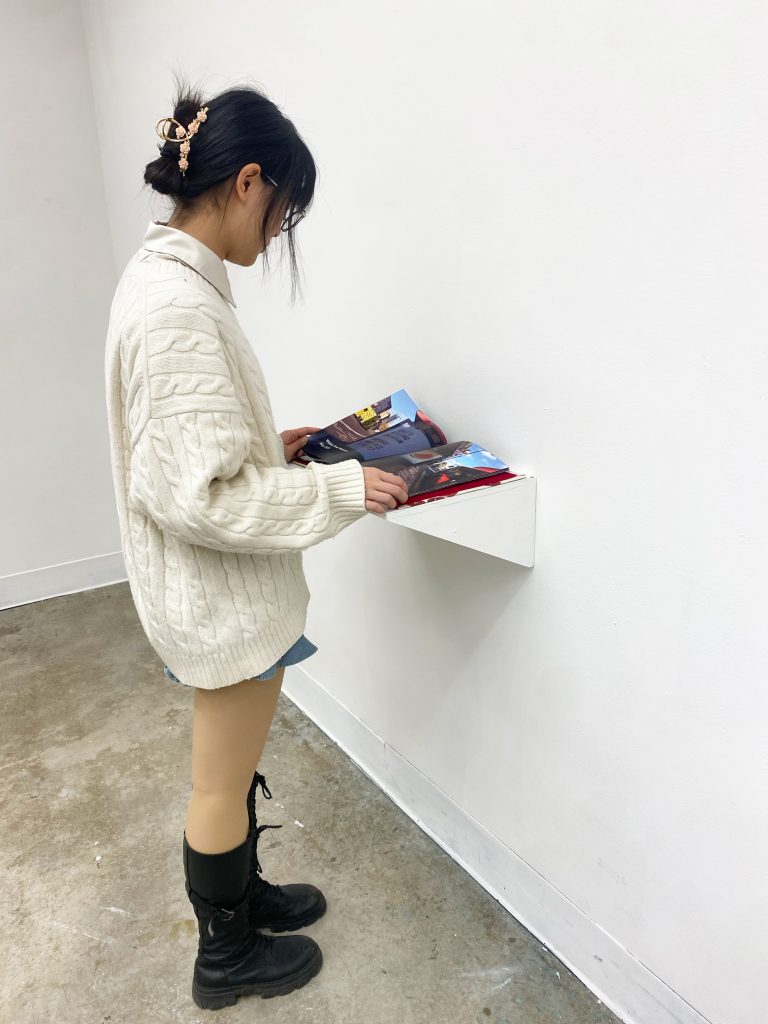
Ali El-Chaer completed a short form publication, Tomorrow’s Grief, that compiled text, news articles, and posters about Palestine and Lebanon from 1982 to 2025. This publication was designed using Adobe InDesign. The intention was to collect and distribute the political posters and stories from or on the topic of Palestine and Lebanon as a way questioning our responsibility to people now.
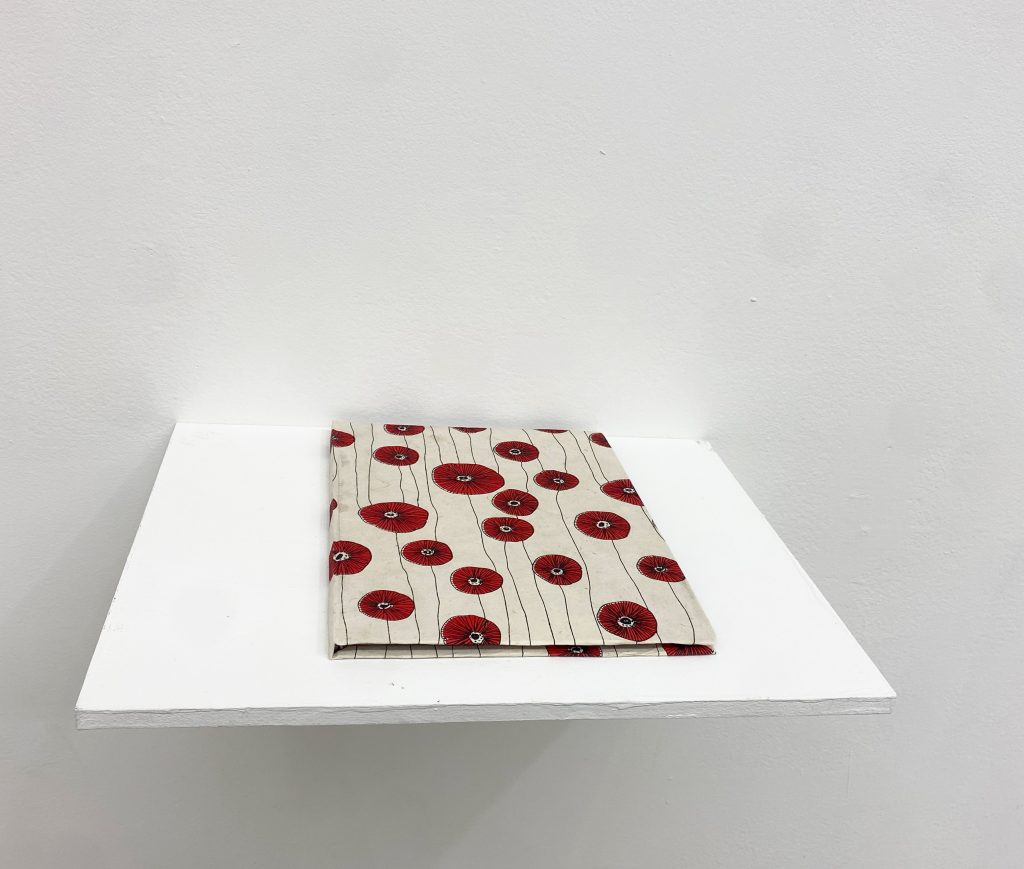
Furthermore, El-Chaer held the goal of understanding dialectical materialism or historic materialism, as a means to understand the superstructures that distract us from real change and show opposition to the economic systems that continue to suffocate freedom. And perhaps by changing the future through new technologies and material change rather than by ideas alone, this remembered historical materialism and knowledge will inform us on how to change the nature of the past as well.  
MFA Design alumni reflect

Corina Coughlan, MFA ‘24
Fellow, Public Policy Lab

Developing human-centered design initiatives to improve public services through conducting user research, developing service design strategies, and collaborating with interdisciplinary teams to prototype and test solutions.

The MFA Design transformed my approach to design and research, encouraging me to ask deeper questions, challenge conventions, and use design as a tool for cultural critique. One of the most rewarding aspects was its interdisciplinary nature, which allowed me to collaborate across university departments and integrate diverse perspectives into my research. This process was instrumental in shaping both my voice as a designer and the direction of my practice.

My MFA research stemmed from a desire to challenge how we see, measure, and communicate lived experience and explore how data can become more human and accessible through visual storytelling and immersive experiences. My thesis exhibition translated these ideas into immersive storytelling through sound, video, and text, offering a more embodied way of understanding movement and data.

Sanaz Feizi, MFA ‘23
Assistant Professor, University of Memphis

Interdisciplinary designer, educator, and researcher whose practice explores the intersection of socio-cultural, biomedical, and biopolitical frameworks.

What I found most valuable about the program was being part of a supportive and collaborative community where faculty were genuinely invested in each student’s growth. The program fostered an environment of mutual encouragement while ensuring we were equipped with the most current and relevant design knowledge. This combination of academic rigor and community support created a unique learning experience that empowered me to develop my own research and creative practice.

My research investigating menstrual stigma and gender inequality, I developed the MAKE TALK Workshop—a research-driven, participatory methodology that leverages dialogic exchange and creative self-expression to surface and challenge normative narratives surrounding menstruation.

Leona Cheung, MFA ‘23
Freelance Designer

Designer and educator based in Los Angeles, working in print and digital projects from branding to websites.

The program allowed us to freely explore many avenues of research relating to our personal interests of study. It was a wonderful experience to develop ideas alongside peers with backgrounds and interests that were diverse, thus creating a rich environment for collaboration. I’m grateful for the support of the faculty, their generosity in sharing knowledge and resources. Not only was it a space to grow my practice and expand the skills for both traditional and contemporary applications of design, but it also taught me how to view things through the lens of greater sensitivity to critical issues.

Sophie Auger, MFA ’21
Visiting Professor, Université du Québec à Montréal

Alongside teaching also works independently and in collaboration with artists, curators, and publishers on exhibitions, publications, and websites.

I was part of the inaugural cohort of the MFA in Design program at Rutgers, and one of only two students. This extraordinary context was both challenging and rewarding: the intimacy of the cohort allowed for individualized engagement, while the generous and dedicated faculty and access to great resources at Rutgers made it a very fruitful experience. The program encourages experimentation in design, art, technology, and interdepartmental research; all of which have enriched my interdisciplinary practice.

My research explored the paradox of the NFT, cryptographically unique yet not interchangeable. This coupled with the intangible nature of a new technology still in the making, fed my thesis work and research. The resulting exhibition explored the aesthetic experience of the NFT, as well as its impact on notions of archiving.