MFA Research Methods visit to the MET

MFA Design’s first year students took a trip to the Metropolitan Museum of Art this month as part of the Research Method’s assignment led by professor Atif Akin (he/him). They explored questions of authorship, history, and genealogy referencing readings completed in class by Michel Foucault and Nietzsche. The goal of this assignment was to look at artifacts within the MET and construct a continuous narrative or genealogy. This assignment could be about anything as long as it was in the MET at the time of the tour. 

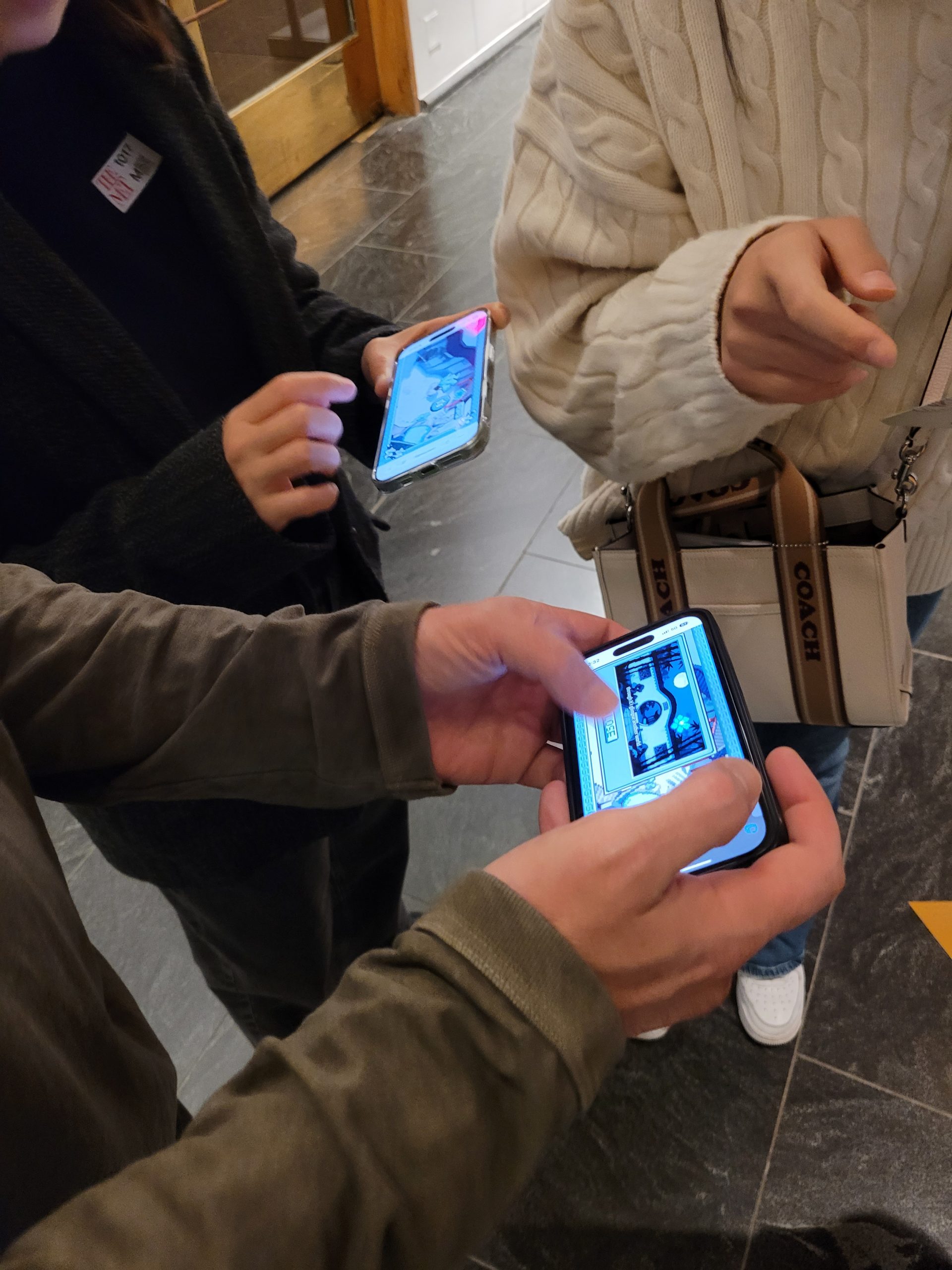
Iris (Qing Zeng, she/her), crafted a pixel solo play through game on Figma, using AI to generate the image. The viewer could explore the garden as a flower and look at formal elements of rocks, wood panels, and architecture. Her tour took place in the Asian Art wing, starting at the moon gate, traversing through the courtyard, and ending thoughtfully in the chamber. Iris has an interest in gaming software and enjoys building narratives and worlds that can engage with her viewer’s feeling of sympathy. Her own voice overlaid the play through text as well as a beautiful soundtrack that set a peaceful tone. Click here to play the game
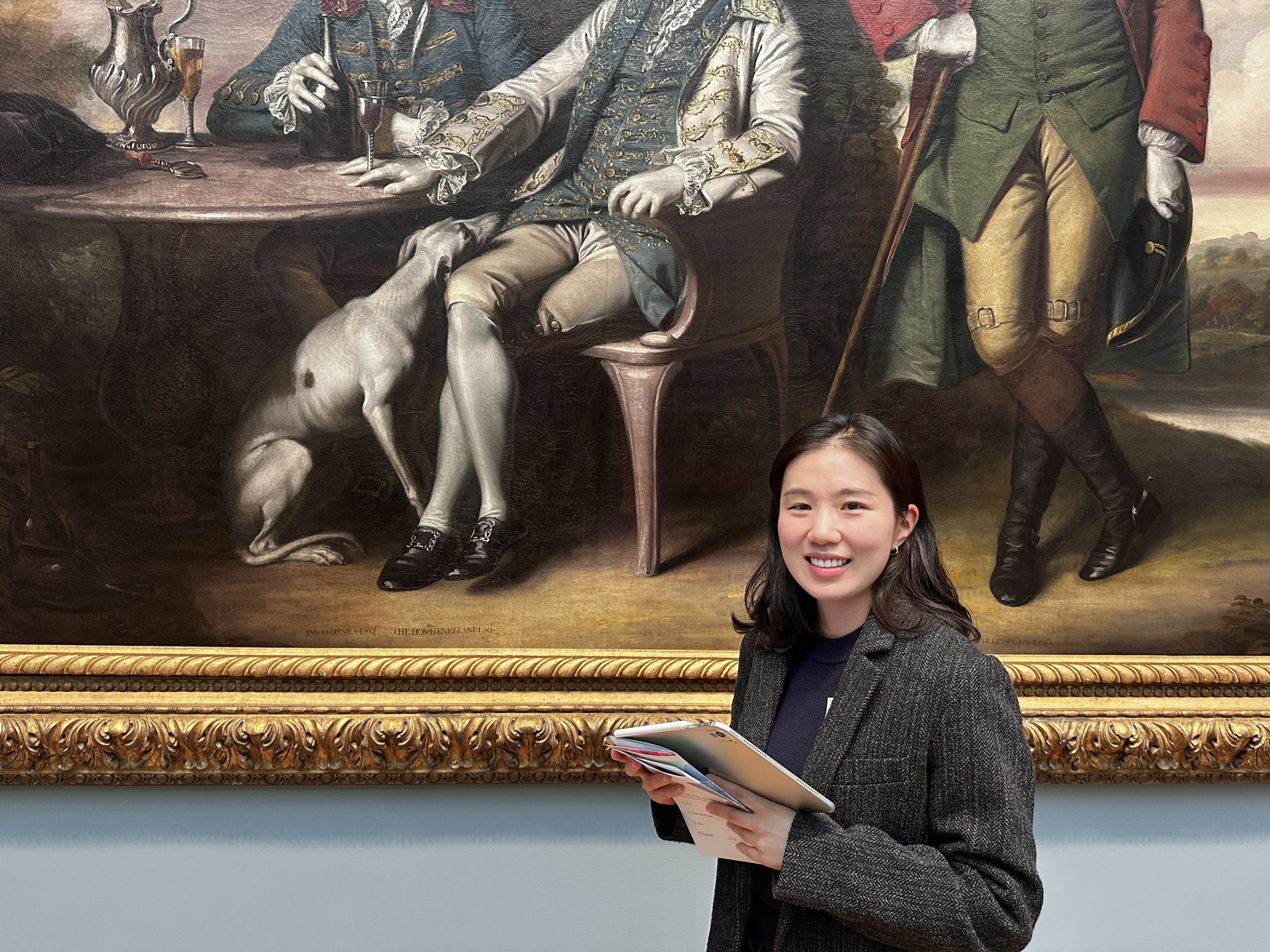
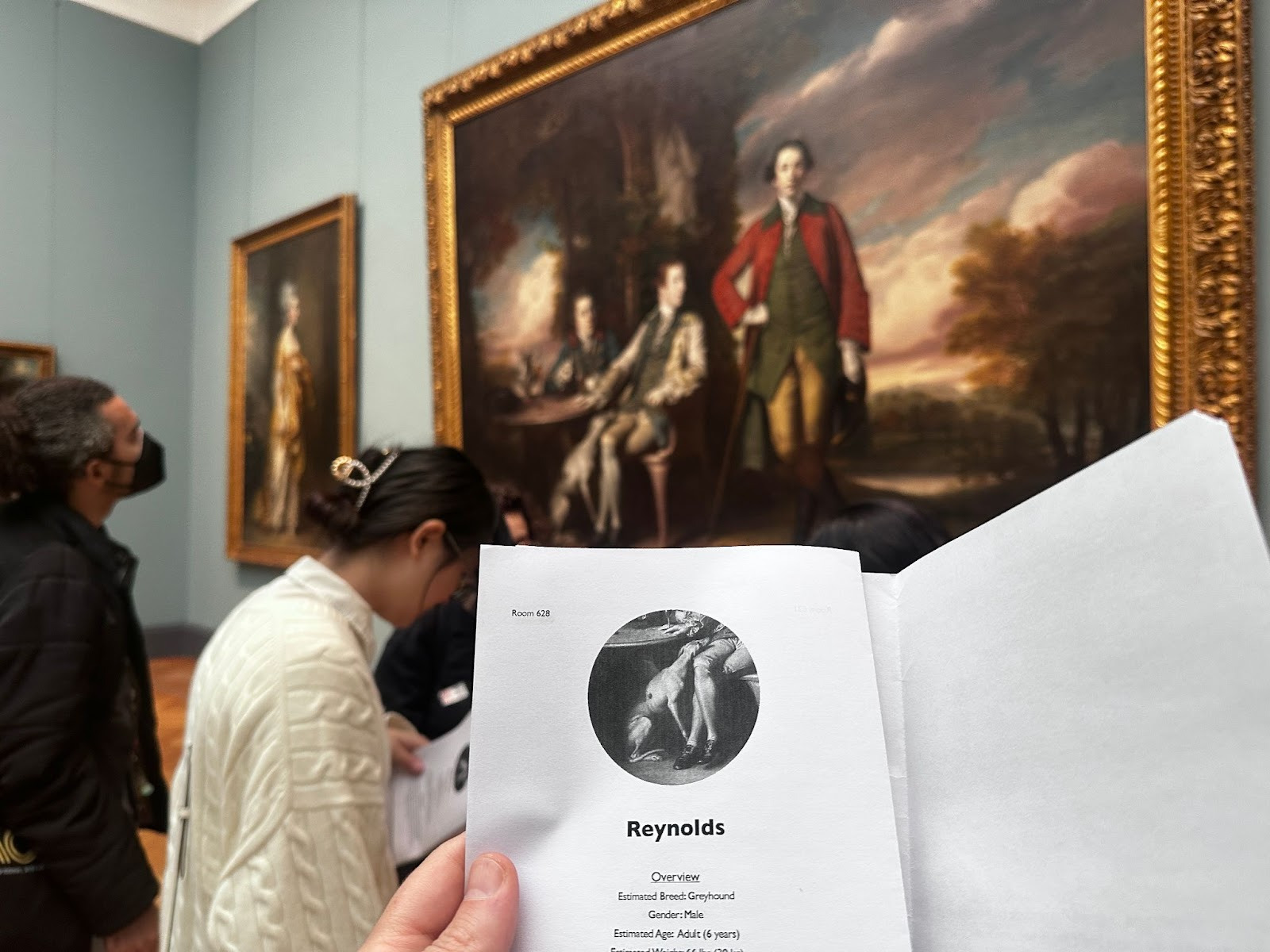
Rachel Jung A Huh (she/her) created a zine that explored the fictional world of a dog shelter, The Canvas Shelter, where the audience could understand a dog’s reason for being placed for adoption and the busy lives of the people in the European Painting Wing. This tour captured the imagination of everyone involved, as all MFA first-year candidates on this tour had their own pups they had to leave behind.

One of the featured dogs was Reynolds, a greyhound whose refined yet confined life mirrored the contradictions of aristocratic society. His story, like those of the other animals, revealed how love, loss, and care intertwine across time and class.

This project reflected on authorship, representation, and empathy, asking who is seen, named, and cared for within institutional narratives. By personifying the museum as a shelter, The Canvas Shelter subverted the power structure of the traditional art museum, turning observation into emotional participation. The narrative concluded with a personal reflection on Rachel’s own adopted labrador retriever, Kahn, whose story bridges the distance between past and present, painting and life, art and care. Ultimately, The Canvas Shelter invited our first year class to adopt not only the forgotten animals of art history but also a more compassionate way of seeing.
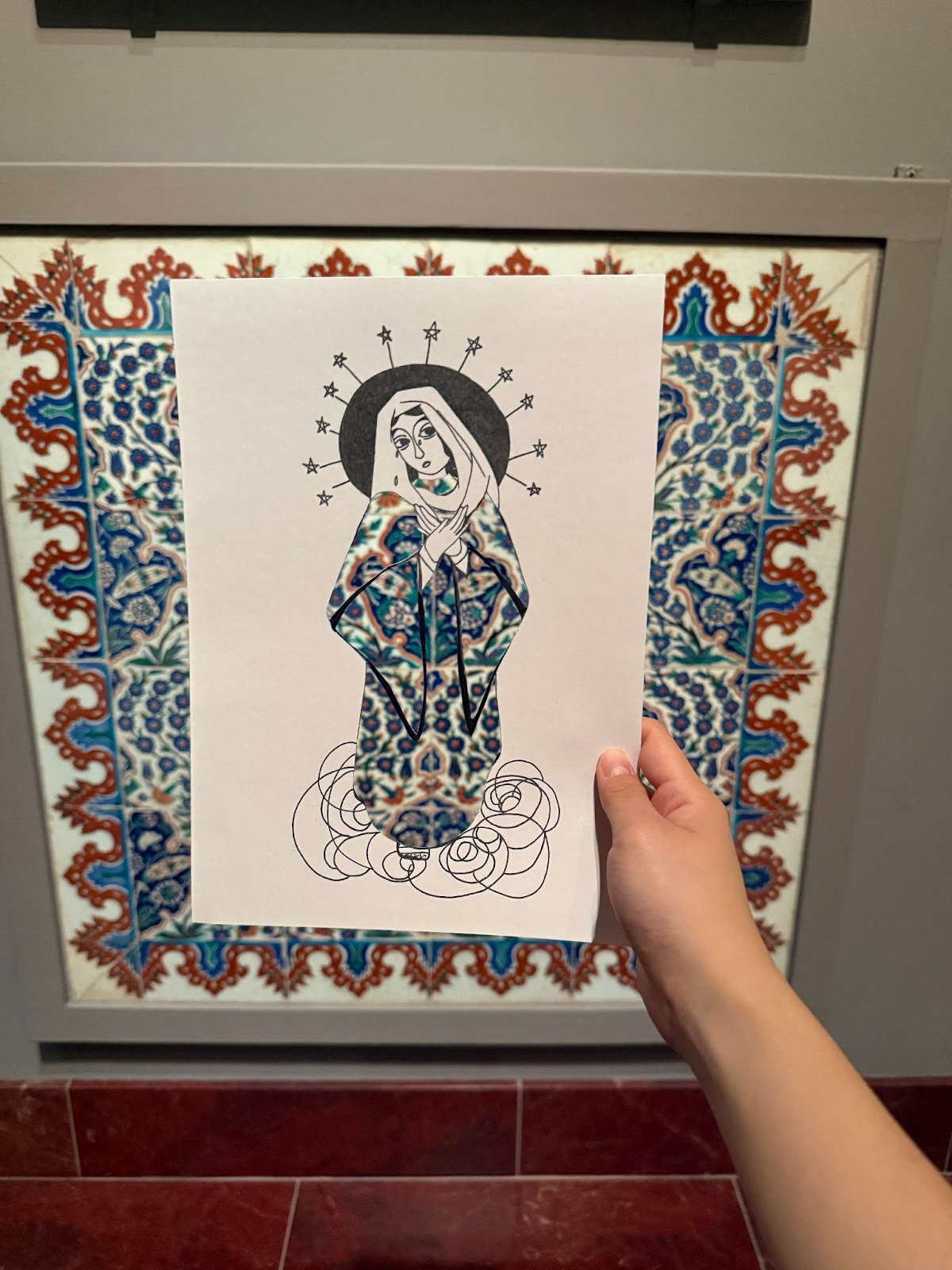
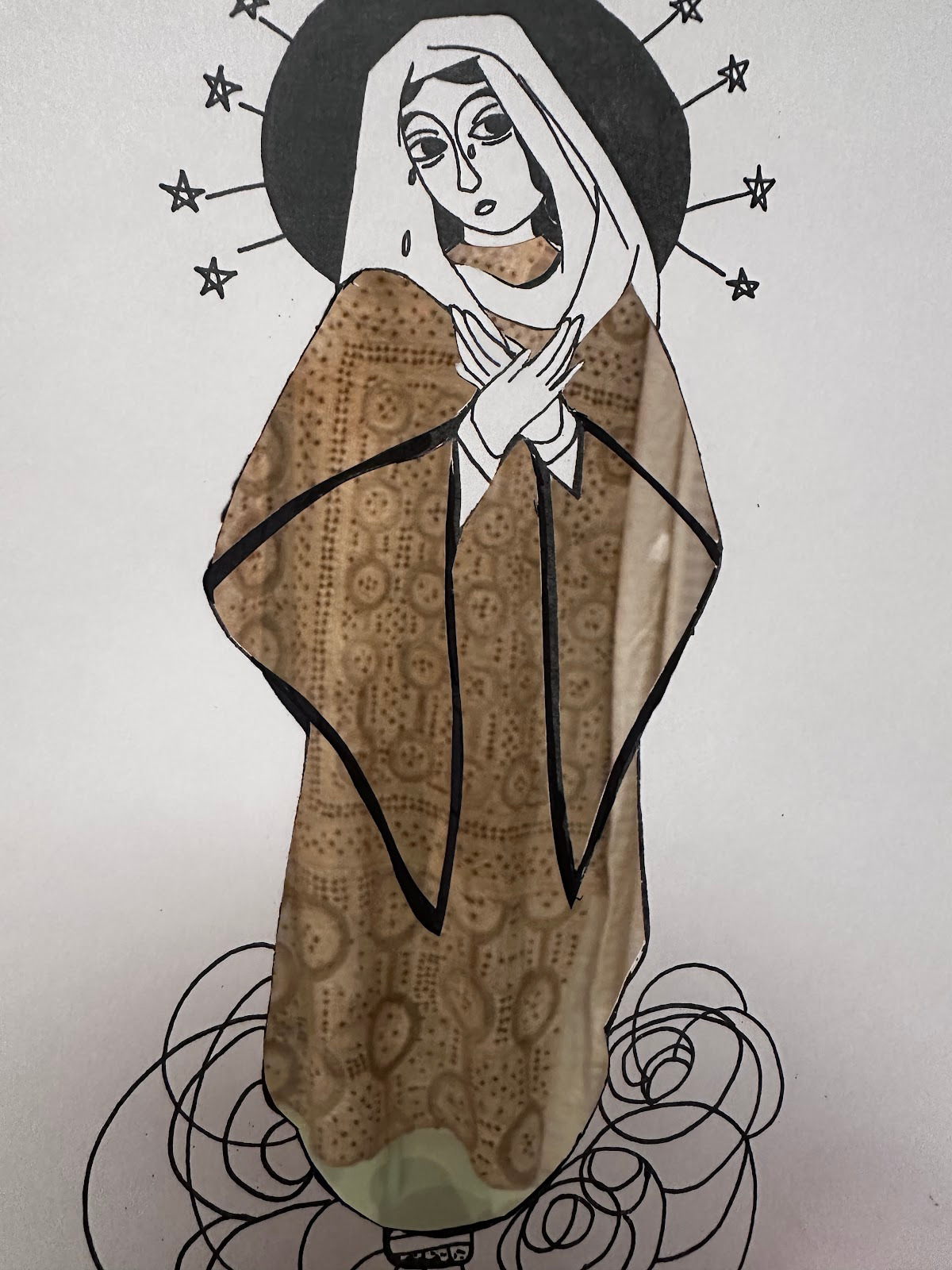
Ali El-Chaer (they/he) created a walk through using the folk story of Joha and his donkey as a guide and to set the tone on cultural appropriation and erasure through the Arab/Islamic art wing. The viewer could use the blank Mary template as a comment on the absence of Palestinian textile/patterns. The use of Mary is also reflective of Ali’s Palestinian Christian background and the importance of her story as a Palestinian woman on a global scale and the Palestinian Christian identity being erased. Viewers were able to dress her up with various other patterns and materials encountered in the same wing and in other places of the museum.

 The MET has Palestinian textiles within their collection but they are not on display. This inspired him to ask questions about artifacts you do not see in a museum for this assignment, what happens when you erase a culture or people from history, and who is allowed to be seen.

Designing Ideologically Modified Organisms

workshop and presentation by

Orkan Telhan
http://orkantelhan.info

February 27, Wednesday 4:00 pm. – 8:00 pm.
CSB 224

Orkan Telhan is interdisciplinary artist, designer and researcher whose investigations focus on the design of interrogative objects, interfaces, and media, engaging with critical issues in social, cultural, and environmental responsibility.

Telhan is Assistant Professor of Fine Arts – Emerging Design Practices at University of Pennsylvania, School of Design. He was part of the Sociable Media Group at the MIT Media Laboratory and the Mobile Experience Lab at the MIT Design Laboratory. He studied Media Arts at the State University of New York at Buffalo and theories of media and representation, visual studies and graphic design at Bilkent University, Ankara. Telhan is working towards his PhD in Design and Computation at MIT’s Department of Architecture.

Telhan’s individual and collaborative work has been exhibited in a number of venues including the Istanbul Design Biennial, Ars Electronica, ISEA, LABoral, Archilab, Architectural Association, Architectural League/ NYC, and the MIT Museum.

Suggested reading before the event:
I. States of Design 07: Bio-design by Paola Antonelli
http://www.domusweb.it/en/design/states-of-design-07-bio-design-/

II.Catts, O., Zurr, I. 2010, ‘The Illusions of control Radical Engineers and Reactionary Artists’, Thresholds (Cambridge), NA, pp. 26

III. Calvert, Jane. 2010. “Synthetic biology: constructing nature?” The Sociological Review 58 (May 1): 95-112.
http://onlinelibrary.wiley.com/doi/10.1111/j.1467-954X.2010.01913.x/abstract

for further inquiries please write to: Atif Akin
poster and e-flier designed by James Brehm.

This is Display

www.thisisdisplay.org

Display is a curated collection of important modern, mid 20th century graphic design books, periodicals, advertisements and ephemera. Documenting, preserving and providing public access to these original materials will raise the profile of Graphic Design as a source of educational, historical and scholarly analysis for teachers, students, designers and independent researchers. From the rational to the experimental to the playful – our collection is varied and represents a distinct point of view about mid-century graphic design, typography and beyond.

Display is organized and designed by Kind Company, an independent web and print design office in Brooklyn, New York. Alongside client work, KindCo engages in self-initiated graphic design history projects. Their websites for the Alvin Lustig Archive and Helvetica and the New York City Subway System help generate inspiration and awareness about graphic design history, pioneers and artifacts. Partners – Greg D’Onofrio and Patricia Belen – are practicing designers, graphic design history enthusiasts, collectors and aspiring writers.

Chicago Design Museum

June 1 – June 30, 2012

By any chance if you find yourself in Chicago, The Chicago Design Museum is open from June 1-30, 2012, in a 6,000 sq./ft. location in Chicago’s Humboldt Park neighborhood. CHIDM will host five exhibitions drawn from local, domestic and international sources. CHIDM will also be hosting events for students and professionals, presented within the context of our curated exhibitions. There is no fee to attend the museum, but there is a suggested $10 donation per visit.

The Chicago Design Museum hosts limited engagement exhibitions that focus on design excellence. It adapts to curated collections, and finds the appropriate environment for the work on display. The formality of a traditional museum is still found within the high standards of the curated work, while the pop-up format promotes intimate experiences that are less likely to be found in a brick-and-mortar institution.

The Chicago Design Museum is a collaborative effort between Mark Dudlik and Tanner Woodford, and is part of Lost Creature: a non-profit 501(c)(3) that aims to bridge culture and creativity with community projects.