It was such a great pleasure to see Sue Huang’s Bodies of Flora last Friday evening at MANA Contemporary. It’s a brilliant collage in real time, gracefully put together, moving with ease between scientific inquiry and personal reflection, and also between archive and storytelling, preservation and memory.
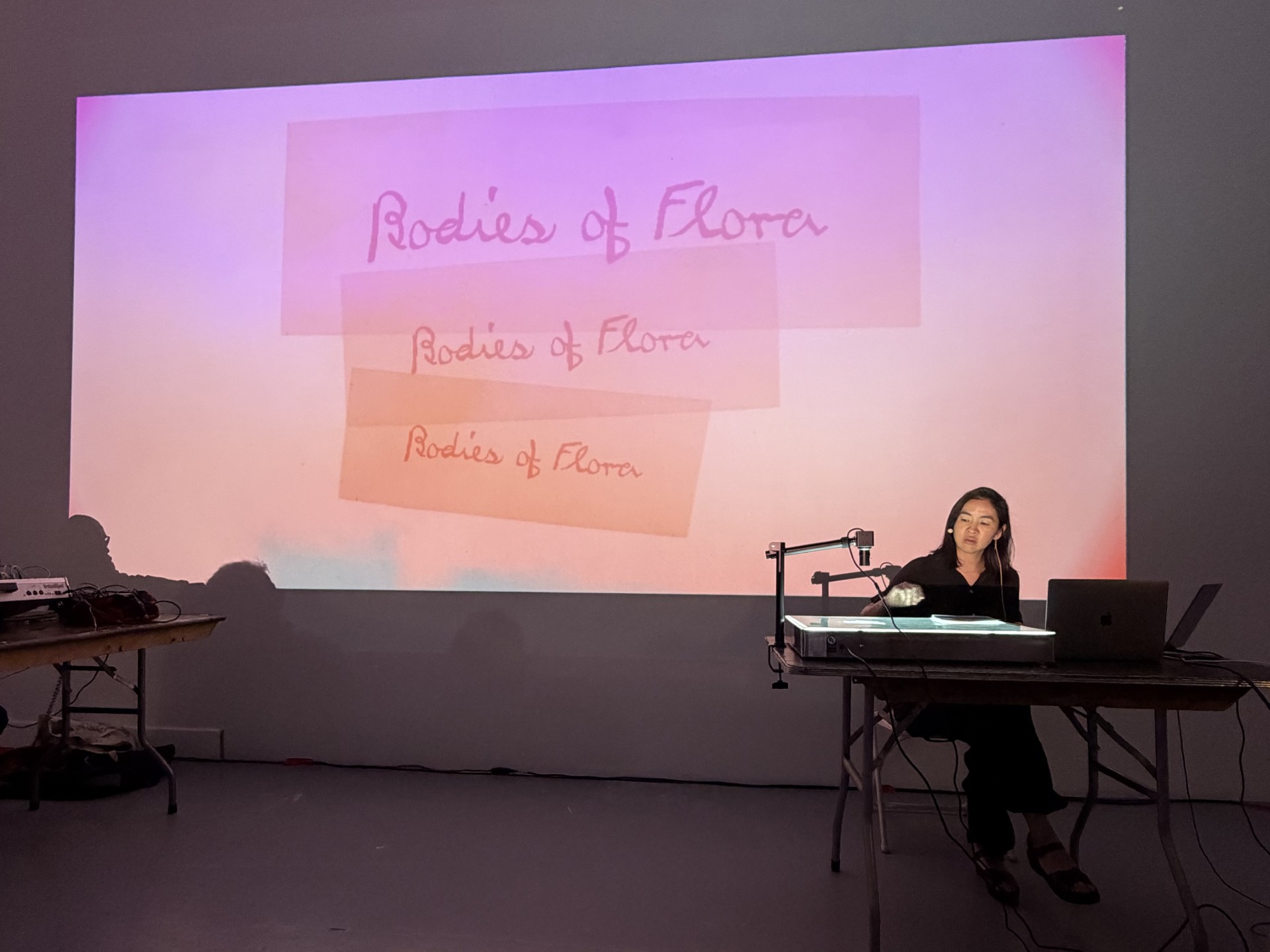
Lorraine Daston writes that botanical nomenclature is “an art of transmission that makes a certain kind of science possible.” Daston’s work kept resonating in my mind while watching Sue’s performance. The naming, cataloging, and preservation of plant life are not simply scientific acts; they are also about memory and cultural practice. Bodies of Flora brings scientific record, autobiography, and artistic interpretation into the same live physical A/V space.
Using an electronic overhead projector, a lightbox with an overhead camera (10x zoom industrial camera often used for scientific magnification), layered with a video channel, Sue created a live visual field where analog and digital image-making sat comfortably together. The setup to evoked the conventional classroom teaching tools and also it was a visual and technical reference to the lightbox at the herbarium, that is the main device for digitizing the specimens. Transparencies contained printed and copied content at scales recalling 4×5 negatives, herbarium sheets, and library stack cards. Sue moved and composed through light by hand. Their tactile archival quality blurred the line between specimen and memory, between scientific preservation and personal reflection. Projection wasn’t used as spectacle, but as a working surface—a place where fragments could be handled, layered, narrated, and transformed. The sound design by Lee Tusman set the atmosphere with a restrained ambient drone. Sue’s storytelling voice, paired with her live gestures on the overhead surface, created a calm but deeply engaging rhythm that pulled the audience in.
It was also so nice to see the broader community around the project. There were roughly twenty-five participants, including MFA in Design students from the last three cohorts. Among them was Asem Kiyalova, who also worked on the project as Sue’s assistant, alongside Anukriti Kaushik. Their contributions make visible another important aspect of Bodies of Flora that is transmission through teaching, collaboration, and shared making.
Carl Linnaeus defined the botanist as someone who can give one particular plant the right name, in a language understood around the world. Bodies of Flora gently expands that idea. It reminds us that our relationship to botanical life is shaped not only by naming, but also by image, touch, story, memory, and care.
Sue has created something intellectually rigorous, elegant, and quietly moving.
for more information about the project and the process:
A Botanical Resurrection: Professor to Visualize a Return of Vanished Flora